Which Business Sectors are adopting real-time AI systems for rapid growth
Discover how healthcare, finance, retail, media, and other sectors use real-time AI to automate complex data analysis.
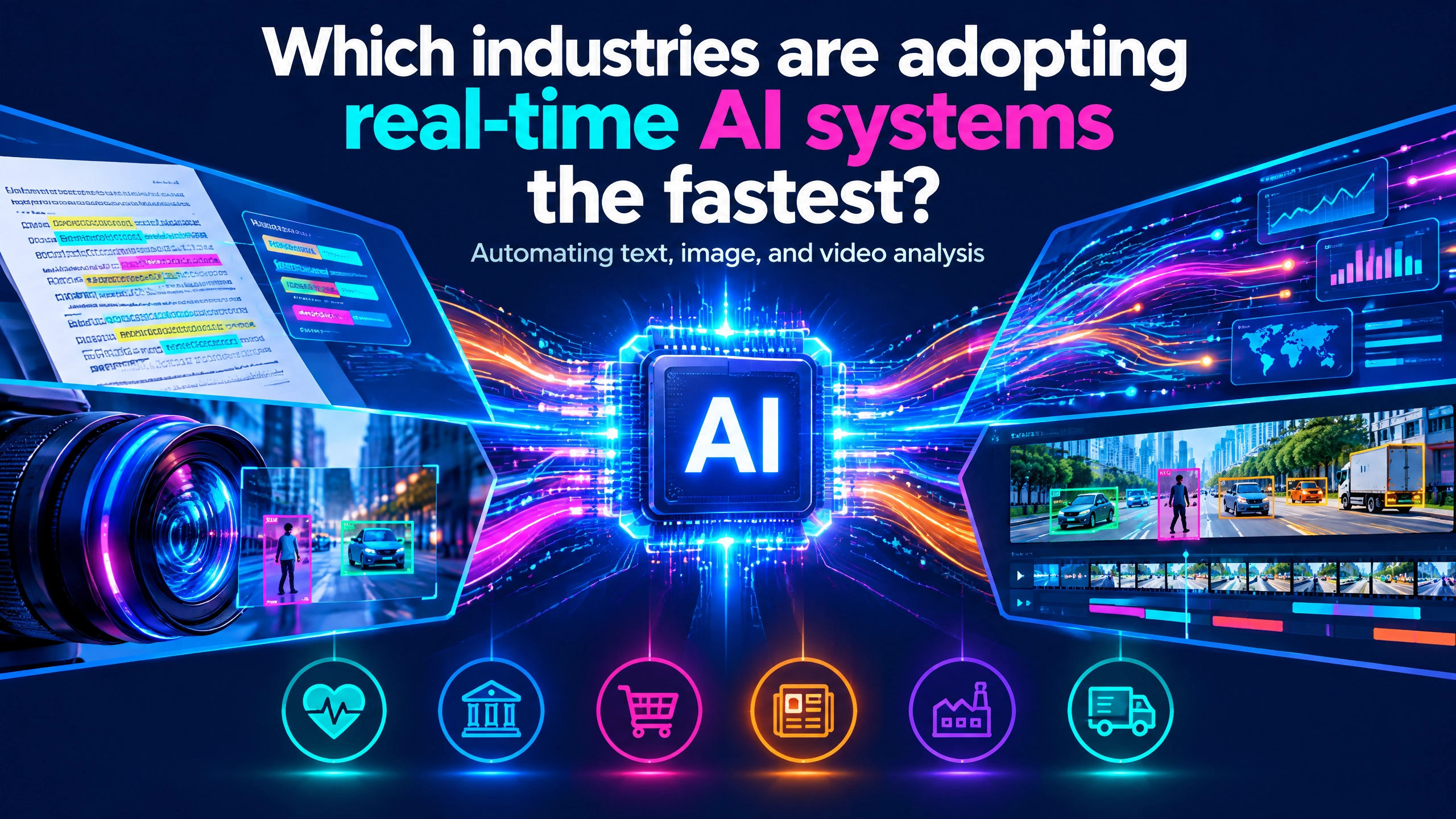
The adoption of real-time AI for analyzing text, images, and video is accelerating at an incredible pace. The "fastest adopting" industries are those where a millisecond-level response provides a direct, significant, and often mission-critical advantage—whether in revenue, safety, or efficiency.
Here’s a breakdown of the industries leading the charge, organized by the speed and depth of their adoption.
Tier 1: The Hyper-Adopters (Real-Time is Core Business)
These industries aren't just experimenting; real-time AI is becoming a fundamental part of their operational DNA.
1. Finance & FinTech
This is arguably the #1 adopter. In finance, a delayed insight can mean millions in losses.
Modality: Primarily Text, with increasing use of Image/Video.
Key Use Cases:
Real-Time Fraud Detection: Analyzing transaction patterns, geolocation, and user behavior (text/event data) the instant a transaction occurs to block fraud.
Algorithmic Trading: Using Natural Language Processing (NLP) to analyze news headlines, social media sentiment, and financial reports in real-time to make automated trading decisions.
KYC & AML: Instantly scanning documents (Image), such as driver's licenses or passports, and cross-referencing them against watchlists (Text) during customer onboarding.
Why so fast? The ROI is immediate and immense. Preventing a single large-scale fraud or capitalizing on a market-moving news story in seconds justifies the massive investment.
2. E-commerce & Retail
The battle for customer attention and wallet share is won or lost in seconds.
Modality: A mix of Text, Image, and Video.
Key Use Cases:
Dynamic Personalization: Analyzing user clicks, search queries, and time-on-page (text/event data) to instantly change product recommendations and promotions. Amazon pioneered this.
Automated Checkout: Computer vision (Image/Video) is used in "just walk out" stores like Amazon Go to identify items customers take and charge them automatically.
Inventory and Shelf Monitoring: Drones or cameras in warehouses and stores scan shelves (image/video) in real-time to flag out-of-stock items and trigger restocking alerts.
Why so fast? Direct impact on conversion rates, average order value, and operational efficiency.
3. Media, Entertainment & Social Media
These platforms are built on understanding and reacting to user-generated content instantly.
Modality: All three: Text, Image, and Video.
Key Use Cases:
Content Moderation: The single biggest driver. Real-time AI scans text posts, images, and live video streams for hate speech, nudity, violence, and copyright violations to remove them before they go viral.
Trending Topic Detection: Analyzing millions of posts, comments, and shares (text) to identify viral content and breaking news as it happens.
Automated Content Tagging: Analyzing video libraries to automatically tag objects, places, and faces (image/video) to improve searchability and content recommendations (e.g., auto-generating highlights in a sports game).
Why so fast? Scale, user safety, and advertiser confidence are paramount. Human moderation is impossible at this scale, and platform-level scandals are a huge business risk. Read USNews recent report on ai fake social media influence
Tier 2: The Rapid Adopters (High-Stakes Transformation)
These industries face significant operational and safety challenges where real-time AI is becoming a game-changer.
4. Manufacturing & Logistics
The move towards "Industry 4.0" is powered by real-time vision systems.
Modality: Primarily Image and Video.
Key Use Cases:
Quality Control: High-speed cameras on production lines analyze products (image/video) 24/7 to spot-minute defects,裂纹, or assembly errors, instantly flagging them for removal. This is far more accurate and faster than the human eye.
Predictive Maintenance: Sensors on machinery stream data (text/event), and vision systems monitor for vibrations, leaks, or wear (video), predicting failures before they cause downtime.
Warehouse Robotics: Vision systems guide robots to identify, pick, and sort packages at lightning speed.
Why so fast? Huge reductions in waste, recalls, and operational downtime. The ROI is measured in millions saved on efficiency.
5. Security & Public Safety
From smart cities to private security, real-time video analysis is the new frontier.
Modality: Almost exclusively Video and Image.
Key Use Cases:
Automated Threat Detection: AI-powered surveillance cameras analyze live video feeds to detect unattended bags, loitering, fights, or weapons, instantly alerting human operators.
License Plate Recognition (LPR): Scanning license plates at checkpoints, parking lots, or on the road in real-time for law enforcement or access control.
Perimeter Security: Detecting and classifying intruders (human vs. animal) at secure facilities in real-time.
Why so fast? The need for proactive threat detection versus reactive review. It enhances security force efficiency and can prevent incidents. The top 5 or 6 ai models right now are not safe according to many ai scholars.
6. Healthcare & Life Sciences
adoption is fast, though often more cautious due to regulation.
Modality: Primarily Image.
Key Use Cases:
Medical Imaging Analysis: AI models can analyze X-rays, CT scans, and MRIs in real-time during a procedure to highlight potential anomalies for the radiologist or surgeon, increasing accuracy and speed.
Operating Room Assistance: Computer vision (video) can track surgical instruments, monitor patient vitals, and provide real-time feedback to surgeons.
Clinical Trial Monitoring: Analyzing patient-reported data (text) from wearables in real-time to detect adverse events.
Why so fast? The potential to save lives and improve diagnostic accuracy is a powerful motivator. The "why" is better patient outcomes and operational efficiency in clinics.
Tier 3: The Emerging & Specialized Adopters
These industries show explosive growth potential in specific niches.
Automotive & Transportation: Video/Text. The development of autonomous vehicles is the ultimate real-time AI project.
Agriculture (Aggrotech): Image/Video. Drones and tractors use real-time AI to identify weeds, pests, or crop health issues for precise treatment.
Sports & Gaming: Video/Text. Real-time player tracking, automated highlight generation, and live betting odds based on in-game events.
Summary Table
| Tier | Industry | Primary Modality | Top Real-Time Driver |
|---|---|---|---|
| 1 | Finance & FinTech | Text | Risk Mitigation & Speed to Market |
| 1 | E-commerce & Retail | Text/Image/Video | Revenue & Competitive Edge |
| 1 | Media & Social Media | Text/Image/Video | Scale, Safety & User Engagement |
| 2 | Manufacturing | Image/Video | Operational Efficiency & Quality |
| 2 | Security | Video/Image | Proactive Threat Detection |
| 2 | Healthcare | Image | Patient Outcomes & Diagnostic Accuracy |
| 3 | Automotive, AgriTech, Sports | Video/Image | Innovation & Niche Dominance |
Final Thought: The fastest adoption is happening where speed directly translates to money saved or made, or where safety and security are on the line. Finance, e-commerce, and media lead because their entire business model is digital and responsive. Manufacturing and security follow closely as the cost of sensors and computing power drops, making AI-powered vision systems a standard tool for competitive operations.
About the author
- My journey began in 2010 with Search Engine Optimization. I spent years studying search behavior, content systems, and the small technical details that help good ideas reach the right people. That foundation taught me to look past the surface and ask how digital systems work underneath. Today, that same curiosity takes me into artificial intelligence, Linux, privacy-first infrastructure, and blockchain. I enjoy translating fast-moving technical ideas into clear explanations, honest experiments, and guides that readers can use immediately.
Comments
Join the discussionNo comments yet. Be the first to comment.